

The IBA Business Growth Model™

A Practical Framework for Accelerating Revenue, Profitability & Enterprise Value
Growth rarely comes from a single initiative. Sustainable business growth requires leaders and advisors to identify the right opportunities, prioritize where to focus, execute with discipline, and continually create greater value.
The Institute of Business Advisors™ (IBA) established The IBA Business Growth Model™ to provide a practical, structured framework for doing exactly that. The model organizes 25 proven growth strategies across five integrated growth pillars, helping advisors and business leaders evaluate opportunities, strengthen performance, and build more valuable businesses.
The IBA Business Growth Model™
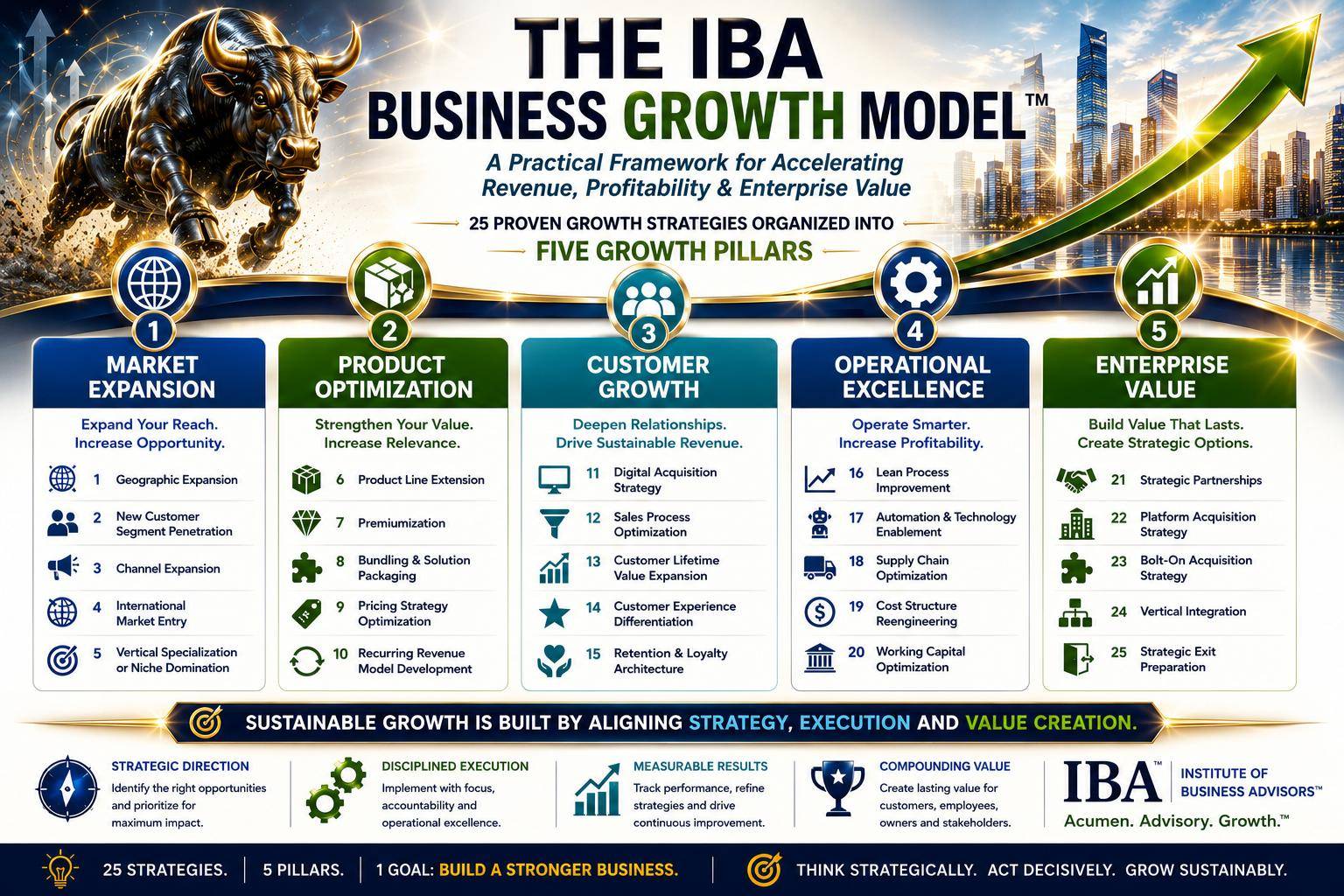
25 Strategies. 5 Pillars. 1 Goal: Build a Stronger Business.
The IBA Business Growth Model™ provides a comprehensive view of business growth—extending beyond revenue alone to encompass market opportunity, product and service value, customer relationships, operational performance, and long-term enterprise value.
Rather than treating growth as a collection of disconnected initiatives, the model provides a disciplined framework for determining where opportunities exist, which opportunities matter most, and how they can be translated into measurable results.
The Five Pillars of Sustainable Business Growth
1. Market Expansion
Expand Your Reach. Increase Opportunity.
Market Expansion focuses on creating growth by reaching new customers, markets, channels, and areas of specialization.
The objective is not simply to “sell more,” but to identify where the business can strategically expand its addressable market and create new sources of demand.
The five Market Expansion strategies are:
- Geographic Expansion
- New Customer Segment Penetration
- Channel Expansion
- International Market Entry
- Vertical Specialization or Niche Domination
For advisors and business leaders, this pillar encourages a fundamental growth question:
Where can the business compete that it is not competing today?
2. Product Optimization
Strengthen Your Value. Increase Relevance.
Growth does not always require finding a new market. Significant opportunity may already exist within what the business sells and how those offerings are structured, positioned, and monetized.
Product Optimization examines ways to strengthen the company’s value proposition, increase customer relevance, and improve the economics of its products and services.
The five Product Optimization strategies are:
- Product Line Extension
- Premiumization
- Bundling & Solution Packaging
- Pricing Strategy Optimization
- Recurring Revenue Model Development
This pillar asks:
How can the business create, package, price, and deliver greater value?
3. Customer Growth
Deepen Relationships. Drive Sustainable Revenue.
Some of the most attractive growth opportunities exist within a company’s current and prospective customer relationships.
Customer Growth focuses on strengthening acquisition, improving conversion, expanding customer lifetime value, differentiating the customer experience, and increasing retention and loyalty.
The five Customer Growth strategies are:
- Digital Acquisition Strategy
- Sales Process Optimization
- Customer Lifetime Value Expansion
- Customer Experience Differentiation
- Retention & Loyalty Architecture
The central question becomes:
How can the business acquire better customers, deepen existing relationships, and create greater lifetime value?
4. Operational Excellence
Operate Smarter. Increase Profitability.
Revenue growth without operational discipline does not necessarily create a stronger business.
Operational Excellence focuses on improving the systems, processes, technology, cost structures, supply chains, and working capital that convert growth into sustainable profitability.
The five Operational Excellence strategies are:
- Lean Process Improvement
- Automation & Technology Enablement
- Supply Chain Optimization
- Cost Structure Reengineering
- Working Capital Optimization
This pillar challenges leaders and advisors to ask:
How can the organization operate more efficiently, profitably, and effectively as it grows?
5. Enterprise Value
Build Value That Lasts. Create Strategic Options.
The ultimate measure of growth is not simply whether a company becomes larger—but whether it becomes stronger and more valuable.
Enterprise Value focuses on strategies that increase strategic capability, strengthen competitive positioning, expand the enterprise, and create future options for owners and stakeholders.
The five Enterprise Value strategies are:
- Strategic Partnerships
- Platform Acquisition Strategy
- Bolt-On Acquisition Strategy
- Vertical Integration
- Strategic Exit Preparation
This final pillar asks:
How can today’s growth decisions create greater enterprise value and strategic optionality tomorrow?
From Growth Strategy to Measurable Results
The IBA Business Growth Model™ is not intended to be a checklist in which every business pursues all 25 strategies.
Its value lies in helping advisors and leaders identify, evaluate, prioritize, and execute the strategies most appropriate for a particular organization.
Effective application of the model follows four fundamental disciplines:
Strategic Direction
Identify the right opportunities and prioritize those capable of producing the greatest impact.
Disciplined Execution
ITranslate priorities into action through focus, accountability, operational discipline, and effective implementation.
Measurable Results
Track performance, evaluate outcomes, refine strategies, and continuously improve.
Compounding Value
Build lasting value for customers, employees, owners, and stakeholders by allowing successful strategies and capabilities to reinforce one another over time.
Sustainable growth is built by aligning Strategy, Execution and Value Creation.
How to Apply the IBA Business Growth Model™
The model can be used as both a diagnostic framework and a strategic growth roadmap.
Rather than beginning with a predetermined solution, advisors and business leaders can use the five pillars to examine the organization systematically and identify where the greatest opportunities—or constraints—exist.
A practical application of the model involves:
- Assess the business across the five growth pillars.
- Identify the strategies with the greatest potential impact.
- Prioritize opportunities based on strategic fit, resources, risk, and expected value.
- Execute selected initiatives with clear accountability and measurable objectives.
- Measure & Refine results and continuously reassess new opportunities.
This disciplined approach helps organizations avoid the common mistake of pursuing growth initiatives simply because they are fashionable, familiar, or immediately available.
Instead, growth becomes intentional, prioritized, measurable, and sustainable.
Two Foundational Models. One Integrated Approach.
IBA’s approach to business advisory is built around two complementary proprietary models:
The IBA Advisory Model™
Defines the capabilities effective business advisors need across Business Acumen, Advisory Capability, and Execution & Growth.
The IBA Business Growth Model™
strengthen business performance and enterprise value.
Together, the two models connect advisor capability with business application.
The IBA Advisory Model™ develops the advisor. The IBA Business Growth Model™ guides the work.
An advisor needs the knowledge and capability to diagnose a business effectively—but also a disciplined framework for determining where and how that capability can create measurable value.
That intersection of acumen, advisory capability, and growth execution is central to the IBA approach.
From Framework to Application
Understanding a growth framework is valuable. Knowing how to apply it is what creates results.
MBA-in-a-Box™, IBA’s proprietary business advisory platform, supports the practical application of the Business Growth Model™ through an integrated ecosystem of business intelligence, advisory tools, professional learning, and practical resources.
Members can deepen their knowledge through:
- ABC Framework Series™ — A-to-Z visual frameworks simplifying complex business disciplines into practical advisory tools
- Executive Book Briefs™ — Actionable insights distilled from leading business books
- Executive Case Briefs™ — Lessons from real-world business successes, failures, turnarounds, and transformations
- IBA Learning Library™ — On-demand business acumen and advisory courses
- Tools, Templates & Advisory Resources — Practical resources for diagnosing opportunities and translating insight into action
- Business Intelligence & Industry Insights — Concepts and intelligence designed to strengthen business acumen and advisory effectiveness
The result is a bridge between knowing what drives business growth and developing the capability to help make it happen.
Developing Growth Advisory Capability
The IBA Business Growth Model™ also provides a practical context for professional development across the IBA credential ecosystem.
Several IBA credentials directly support capabilities required to diagnose, advise, execute, and create value across the five growth pillars, including:
Certified Business Growth Advisor™ (CBGA™)
Focused on translating business strategy into measurable revenue and profit growth.
Certified Corporate Growth Advisor™ (CCGA™)
Focused on enterprise-level growth, scale, execution, and value creation.
Certified Business Advisory Professional™ (CBAV™)
Develops the advisory capability required to diagnose business challenges, guide decisions, and become a trusted business advisor.
Certified Private Equity Advisor™ (CPEA™)
Applies business acumen, value creation, and growth strategy across the private equity lifecycle.
Certified Lean Six Sigma – Yellow Belt™ (CLSS-YB™)
Strengthens disciplined problem solving, process improvement, and operational performance.
These credentials complement the Business Growth Model™ by helping professionals develop and validate capabilities relevant to growth advisory, execution, and value creation.
Why the IBA Business Growth Model™ Matters
For Advisors
- Provides a structured framework for diagnosing business growth opportunities
- Expands advisory conversations beyond a single functional specialty
- Helps connect recommendations to measurable business outcomes
- Creates a common language for discussing growth, profitability, and value creation
- Strengthens the transition from subject-matter expert to broader business advisor
For Businesses & Organizations
- Creates a comprehensive view of potential growth opportunities
- Helps leadership prioritize among competing initiatives
- Connects revenue growth with operational performance and profitability
- Encourages disciplined execution and measurement
- Aligns near-term growth with long-term enterprise value
Think Strategically. Act Decisively. Grow Sustainably.
The IBA Business Growth Model™ recognizes that sustainable growth is rarely the result of one idea, one initiative, or one functional discipline.
It is created by systematically identifying opportunity, making better strategic choices, executing with discipline, measuring results, and continually building greater value.
25 Strategies. 5 Pillars. 1 Goal: Build a Stronger Business.
Acumen. Advisory. Growth.™